Lyme Disease Research Database
Hello and welcome to the LDRD

The White Pages Bot service is a leader among white page generators, providing unique capabilities for creating pages of any theme, tailored to any geographical location, advertising offers, and in any language. This service is perfect for marketers and traffic arbitrageurs who need a reliable and versatile tool for generating high-quality white pages of any theme, which are guaranteed to pass moderation on FB Ads, Bing Ads, Google Ads, TikTok Ads, and any other advertising network. With an intuitive interface and a plethora of unique templates, Whitepages.bot allows for the rapid creation of pages containing essential contact information and other pertinent data in an organized and appealing format. Regardless of the audience you are targeting—local, national, or international—WhitePages.bot provides all the necessary tools for effectively enhancing your online business. Learn more about white page creation capabilities on the WhitePages.Bot website or on the Telegram White Pages Bot and see how this service can transform the presentation of your information and ensure moderation approval in any advertising network worldwide without triggering the "Infected Site" error in Google Ads and other advertising networks.

My journey is probably similar to yours. Our stories are a variation on the same basic plot: Illness, misdiagnosis, searching for answers. Or perhaps you’ve completed the standard antibiotic therapy and yet you’re still sick. We all seek the same outcome, the same happy ending that will help us push our way out of the fog of Lyme. We want answers to our questions, and we want the treatment and support we need to heal completely.

What do doctors think about the current treatment options? Do you want to hear from a doctor how they treat Lyme?
Maybe you're curious about people who are beating Lyme, and want to know what types of protocols they're following?
Want to hear from the scientists themselves about current medical research on Lyme Disease and related tick-borne illnesses?
Sign up here for immediate access to audio interviews with experts, Lyme Disease survivors, and to learn about cutting-edge developments.

Read about every aspect of dealing with and healing from Lyme. We take an integral approach: Beat Lyme from every angle—body, mind, spirit. You can read inspiring success stories here, and find useable info about protocols, therapy, nutrition and diet, herbs, supplements, exercise, and alternative and complementary healing. From the despair and frustration of misdiagnosis to the joy of feeling vibrantly alive again—these posts contain a wealth of information on what has worked for me and for many others. Dive in!
Read the LDRD Journal

Hear doctors who represent a broad range of medical perspectives—from conventional to alternative to integrative therapies. We ask, and they talk about Lyme disease symptoms, diagnosis, treatment, and prevention. If you are struggling with Lyme, you need reliable resources to assist in your quest to recover.
Learn more

All of us who struggle with Lyme Disease can empathize. We see pieces of our own stories in other people's experiences. We've walked through many of the same doors, and heard some of the same reactions to our illness. “You don’t look sick!” our well-meaning friends might say. Although each of our stories are unique, together they can help us understand the common threads that can eventually lead us back to vibrant health.
Learn more
Join the LDRD for only $15 per month!
What do Lyme-literate experts think about current treatment options? Would you benefit from listening to doctors talk about how they treat Lyme?
People who heal from Lyme Disease often walk away and never look back. (Personally, I don’t blame them!) But those who are still suffering want to know how they did it. What protocols did they follow, and what else can be learned from hearing their personal stories?
Want to hear from scientists themselves about current research on Lyme? What is happening in the research communities regarding Lyme and related tick-borne illnesses?

If you’ve dealt with chronic Lyme, you know that symptoms can come back once you’ve finished with antibiotics. Healing can be a long, slow journey and not everyone finds the strength to persevere. Recovered from Lyme, author Suzanne Arthur tells her story of misdiagnosis and healing, addressing the confusion and difficulties of treatment.
You’ll learn about:
- What the experts have to say about Lyme treatment
- Fighting Lyme from every angle with an Integral approach
- Living a healthy post-Lyme life with diet, stress management, and exercise
This integral framework is being used by cutting-edge integrative doctors and patients dealing with cancer and other life-threatening illnesses. You can learn to apply it to your own healing. Lyme Disease, especially late-stage Lyme, is complex, affecting all the systems in the body and brain. The framework makes it easier to see the big picture and yet not lose sight of the details. Think of it as an organizing lens through which you can examine all the facets of the disease, and all approaches to healing. Looking at Lyme this way can help you be more effective in your treatment.
Using this method will show you how all aspects of the illness interact. Not simply the physical and neurological symptoms, but also how your actions are influenced by other fundamental dimensions of the disease. Raise your awareness and broaden your options.
Learn more
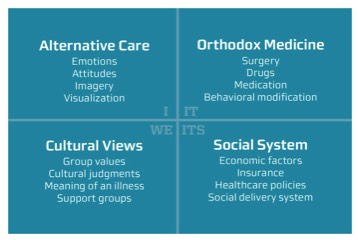
4 Quadrants of Integral Medicine. Integral Vision (Wilber, 2007).
Introduction to Lyme Disease
What is Lyme Disease
Lyme disease is a multi-system inflammatory disease that affects all the systems of the body, including the brain. Although every case is different, left untreated, Lyme disease can be devastating. Read articles on Lyme disease.
Causes and Risk Factors
The specific bacteria that causes Lyme is a spirochete called Borrelia burgdorferi, and it is believed to be primarily spread through the bite of a deer tick. Those who live near, or visit, densely forested areas are believed to be at higher risk of exposure to ticks, yet increasing medical evidence suggests that the bacteria can spread through other means.
Lyme Disease Symptoms
Lyme can cause fever, headaches, body aches, and crushing fatigue. Some patients develop a characteristic bull’s-eye skin rash at the location of the tick bite. Lyme can also affect the cardiac system and the brain, causing arrhythmia, vertigo, speech impairments such as stammering, and poor concentration. Palsy and facial paralysis are also symptoms of Lyme. It is not uncommon for patients to suffer mood swings, depression, and psychotic episodes such as hallucinations.

Tests and Diagnosis
Currently, the recommended diagnostic tests for detecting Lyme disease are the Western Blot analysis, used to identify particular antibodies, and the ELISA, a general antibody test. Tests for the disease are unreliable. Negative clinical test results do not necessarily mean that the patient is free of Lyme or its co-infections. The bacteria appears to evade the body's immune system, as it is capable of changing into two, three or more shapes as it spreads throughout the body. Learn more about Lyme disease tests.
Unfortunately, it is common for people with Lyme to receive a misdiagnoses and thus remain untreated. The medical profession’s nickname for Lyme Disease is the Great Imitator, because symptoms mimic hundreds of other conditions including Multiple Sclerosis, Chronic Fatigue Syndrome, Epstein-Barr virus, and rheumatoid arthritis. Learn more about Lyme disease diagnosis.
Lyme Treatment
Lyme disease is treatable with antibiotics. However, there are two standards of care among the experts. The strength and length of prescription of antibiotics sits at the core of controversy in the medical community. Antibiotics given immediately after infection seem to work for most Lyme patients. During later stages of the disease, some patients have responded to extended courses of antibiotics, but extended courses are not sanctioned by the Centers of Disease Control and Prevention (CDC) or the Infectious Diseases Society of America (IDSA). On the other hand, current guidelines for treatment of Lyme published by the International Lyme and Associated Diseases Society (ILADS) state that it is reasonable to continue antibiotic therapy, in some cases, beyond the arbitrary 30-day course recommended by the IDSA. Learn more about Lyme disease treatment protocols.

Alternative Medicine
Increasingly, LLMDs are treating patients successfully with combinations of therapies. They may combine protocols, such as pharmaceutical and herbal antimicrobials used together. They may prescribe other non-invasive methods, such as Hyperbaric Oxygen Therapy. Further, doctors are seeing fewer cases of relapse in patients who are treated with some of these alternative protocols. Learn about alternative Lyme treatments.
For Patients
People suffering the symptoms and stress of Lyme Disease are caught in a difficult paradox. At the time they feel most compromised and unable to make important choices for their healing, they must choose a course of action. They need accessible information to help them make sound decisions about the course of their own treatment. The Lyme Disease Research Database aims to be a resource for patients seeking education about diagnosis, treatment, and prevention of the disease. It offers support for identifying and alleviating Lyme symptoms, and news of current treatments, both conventional and alternative. Listen to interviews with Lyme patients.
For Health Professionals
The Lyme Disease Research Database (LDRD) helps provide a platform for health professionals, LLMDs, researchers, patients, medical experts and other licensed health care practitioners to speak directly to others in the Lyme community. Health professionals share up-to-date information about therapies that are effective for patients with Lyme Disease. In addition, LDRD also showcases stories of patients who are successfully overcoming Lyme disease.
© 2005 - 2018 Pixel Ink Design: By accessing and/or reading this website you agree to the terms of use and privacy policy. You agree that every page on this website is subject to our legal disclaimer.